|
[Date Prev][Date Next][Thread Prev][Thread Next][Date Index][Thread Index] Re: RFC: unmap_page_range optimisation (avoiding emulation faults during VM migration)
Adding Juergen

Le 12/02/2026 à 18:50, Edwin Torok a écrit :
> Hi,
>
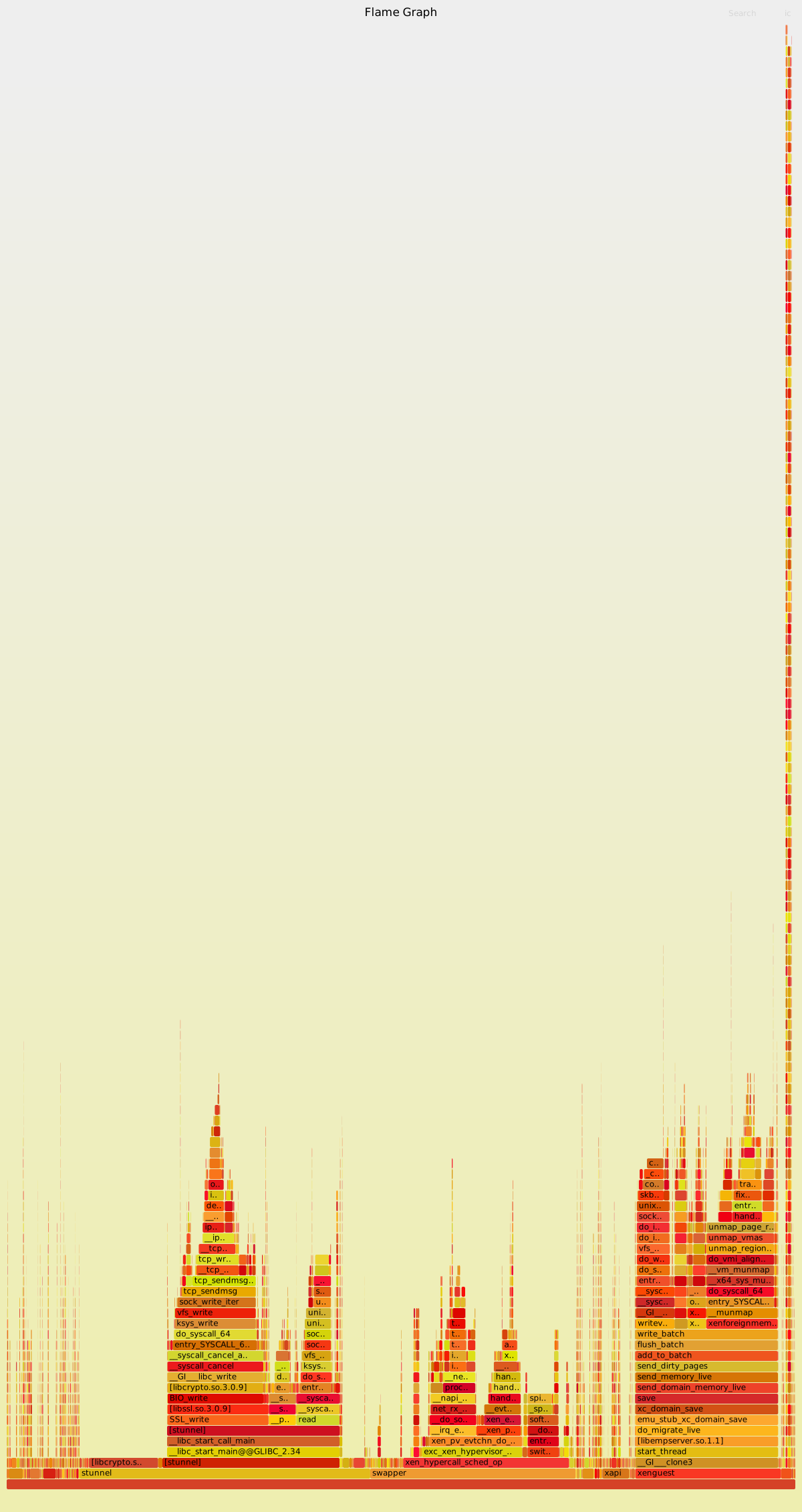
> When profiling a VM migration I noticed that on the sender side a significant
> (~45%) time is spent in PV Dom0 Linux taking an emulation fault in
> unmap_page_range [1]:
>
> The call comes from zap_pte_range (pgtable_64.h, inlined):
>   ptent = ptep_get_and_clear_full(mm, addr, pte, tlb->fullmm);
>
> This has 2 implementations: native and a generic one where pte_clear is
> implemented using set_pte_at with a Xen pvop.
>
> As a proof of concept I’ve deleted the native implementation [2], which makes
> it fall back to the generic implementation [3].
> This is not necessarily safe on SMP (it reads and clears as 2 separate
> steps), but shows that a paravirt op is faster than emulation.
>
> To fix this we may need to partially revert
> https://git.kernel.org/pub/scm/linux/kernel/git/torvalds/linux.git/commit/?id=4cdd9c8931767e1c56a51a1078d33a8c340f4405
>
> To test this more easily I’ve written a small test program that maps/unmaps
> pages from a domain in Dom0 [4].
> Before: 3.26932 +- 0.00503 seconds time elapsed  ( +-  0.15% )
> After: 0.75642 +- 0.00202 seconds time elapsed  ( +-  0.27% )
>
> It is more than 4x faster to use the paravirt ops than trapping and emulating.
>  From a functional point of view the above commit is correct, Xen doesn’t
> need a dedicated PV operation: trap and emulation works.
> But from a performance point of view I’d say that Xen does need it. This is a
> hot-path during migration, and it’d be worthwhile to optimise it.
>
> Just deleting the native implementation is probably not the solution, since
> we also want a value returned, and the existing PV operation is void.
> It probably needs a new PV operation (re)introduced with the desired
> semantics?
>

I can't find a MMUEXT hypercall which does roughly xchg on the
pagetable. You can write a entry through MMU_NORMAL_PT_UPDATE, but not
reading it before writing it atomically (xchg).

Maybe there is a way to achieve it, but otherwise, it would need a new
dedicated hypercall and related code for Linux.

> Best regards,
> --Edwin
>
> [1]:
> https://cdn.jsdelivr.net/gh/edwintorok/xen@pmustack-coverletter/docs/tmp/migrate-send.svg?x=950.6&y=2197
>
> [2]:
> diff --git a/arch/x86/include/asm/pgtable.h b/arch/x86/include/asm/pgtable.h
> index 690c0307afed..ab6318bb5676 100644
> --- a/arch/x86/include/asm/pgtable.h
> +++ b/arch/x86/include/asm/pgtable.h
> @@ -1097,13 +1097,9 @@ extern int ptep_test_and_clear_young(struct
> vm_area_struct *vma,
>   extern int ptep_clear_flush_young(struct vm_area_struct *vma,
>                                    unsigned long address, pte_t *ptep);
>
> -#define __HAVE_ARCH_PTEP_GET_AND_CLEAR
> -static inline pte_t ptep_get_and_clear(struct mm_struct *mm, unsigned long
> addr,
> -                                      pte_t *ptep)
> -{
> -       pte_t pte = native_ptep_get_and_clear(ptep);
> -       return pte;
> -}
> +static inline pte_t ptep_get_and_clear(struct mm_struct *mm,
> +                                      unsigned long address,
> +                                      pte_t *ptep);
>
>   #define __HAVE_ARCH_PTEP_GET_AND_CLEAR_FULL
>   static inline pte_t ptep_get_and_clear_full(struct mm_struct *mm,
>
> [3]:
> #ifndef __HAVE_ARCH_PTEP_GET_AND_CLEAR
> static inline pte_t ptep_get_and_clear(struct mm_struct *mm,
>                                         unsigned long address,
>                                         pte_t *ptep)
> {
>          pte_t pte = *ptep;
>          pte_clear(mm, address, ptep);
>          return pte;
> }
> #endif
> static inline void pte_clear(struct mm_struct *mm, unsigned long addr, pte_t
> *ptep) { set_pte_at(mm, addr, ptep, __pte(0)); }
>
> [4]:
> $ cat >main.c <<EOF
> #include <assert.h>
> #include <stdio.h>
> #include <stdlib.h>
> #include <sys/mman.h>
> #include <xenctrl.h>
> #include <xenforeignmemory.h>
>
> int main(int argc, char *argv[]) {
>    if (argc != 3) {
>      fprintf(stderr, "Usage: %s <domid> <batchsize>\n", argv[0]);
>      return 1;
>    }
>    uint32_t domid = atoi(argv[1]);
>    uint32_t batch_size = atoi(argv[2]);
>
>    if (!domid || !batch_size) {
>      fprintf(stderr, "Invalid arguments, expected 2 integers");
>      return 2;
>    }
>
>    xenforeignmemory_handle *handle = xenforeignmemory_open(NULL, 0);
>    if (!handle)
>      return 3;
>
>    xc_interface *xc = xc_interface_open(NULL, NULL, 0);
>    if (!xc)
>      return 4;
>
>    xen_pfn_t nr_pfns;
>    if (xc_domain_nr_gpfns(xc, domid, &nr_pfns) < 0)
>      return 5;
>
>    unsigned mappings_size = nr_pfns / batch_size + 1;
>    void **mappings = calloc(mappings_size, sizeof(void *));
>    if (!mappings) {
>      perror("calloc");
>      return 6;
>    }
>
>    for (xen_pfn_t i = 0; i < nr_pfns; i += batch_size) {
>      xen_pfn_t arr[batch_size];
>      int err[batch_size];
>
>      for (unsigned j = 0; j < batch_size; j++)
>        arr[j] = i + j;
>
>      unsigned long idx = i / batch_size;
>      assert(idx < mappings_size);
>      mappings[idx] = xenforeignmemory_map(
>          handle, domid, PROT_READ, sizeof(arr) / sizeof(arr[0]), arr, err);
>      if (!mappings[idx])
>        return 7;
>    }
>
>    for (xen_pfn_t i = 0; i < nr_pfns; i += batch_size) {
>      unsigned long idx = i / batch_size;
>      assert(idx < mappings_size);
>      if (xenforeignmemory_unmap(handle, mappings[idx], batch_size))
>        return 8;
>    }
>
>    free(mappings);
>    xc_interface_close(xc);
>    xenforeignmemory_close(handle);
>
>    return EXIT_SUCCESS;
> }
> EOF
>
> $ cat >meson.build <<EOF
> project('xfm_scale', 'c', default_options:['c_std=gnu11'])
> xfm = dependency('xenforeignmemory')
> xc = dependency('xencontrol’)
> executable('xfm_scale', 'main.c', dependencies: [xfm, xc])
> EOF

Teddy


--
Teddy Astie | Vates XCP-ng Developer

XCP-ng & Xen Orchestra - Vates solutions

web: https://vates.tech
|
 |
Lists.xenproject.org is hosted with RackSpace, monitoring our |